Slab Leak Detection & Repair in Las Vegas, NV
Las Vegas homes sit on concrete slabs over some of the most copper-hostile ground in the country — extremely hard Colorado River water inside the pipes, corrosive alkaline desert soil outside them. Now the 1990s and 2000s tract-home boom is hitting pipe-failure age, and slab leaks are surging from Summerlin to Rhodes Ranch. Our same-day pros provide slab leak detection and repair across Las Vegas, Nevada, using acoustic listening, thermal imaging, and tracer-gas testing to pinpoint leaks within inches of their source — no exploratory jackhammering, no guesswork. Whether it's a warm spot on the tile in Southern Highlands, a spiking water bill in Spring Valley, or the sound of running water under a quiet Centennial Hills home, we confirm the diagnosis in a single visit and hand you a written repair estimate. Every hour a pressurized line leaks under your slab, it erodes soil and threatens your flooring and foundation. Call today for same-day slab leak detection in Las Vegas before a small leak becomes a major restoration.
Neighborhoods We Serve in Las Vegas
Summerlin, Downtown Las Vegas, Spring Valley, Centennial Hills, Aliante, Southern Highlands, Rhodes Ranch, Skye Canyon, The Lakes, Paradise — and every ZIP code in between.
Why Las Vegas Homes Get Slab Leaks
The Las Vegas Valley floor is caliche — a rock-hard layer of calcium carbonate — over alkaline desert soil that corrodes copper from the outside in. Inside the pipe, extremely hard Colorado River water pits and thins copper relentlessly. Slab-on-grade construction is universal, summer soil temperatures swing violently under sun-baked concrete, and the resulting expansion-contraction cycle has been working every buried joint since the 1990s–2000s building boom.
Why Las Vegas Homes Get Slab Leaks
Las Vegas wasn't built gradually — it exploded. The 1990s and 2000s added hundreds of thousands of tract homes in Rhodes Ranch, Southern Highlands, the Summerlin expansions, Skye Canyon's early phases, and across the southwest valley, nearly all of them with copper water lines buried under slab-on-grade foundations. Copper's realistic service life in harsh conditions is 30 to 50 years, which means that entire generation of plumbing is entering its failure window right now, all at once. The water makes it worse: Las Vegas draws heavily on the Colorado River, and that water is extremely hard and mineral-laden. Inside the pipe, minerals and chemistry pit and thin the copper; outside the pipe, the valley's alkaline caliche soil corrodes it from the other direction. Add the Mojave's punishing summer heat — soil temperatures under a sun-baked slab swing dramatically between day and night — and copper lines endure constant thermal expansion and contraction that flexes every joint. Older pockets of the city tell the same story on an accelerated timeline: downtown and The Lakes have mid-century homes whose original copper is 50-plus years old. And because slab-on-grade is essentially universal in Las Vegas, there is no crawlspace to catch an early drip — the first symptom is usually damage to the finished floor or a shocking water bill. The result is predictable: neighborhoods built in the same five-year window tend to see slab leaks cluster together, sometimes on the same street, as the whole area's copper ages out in unison.
Signs of a Slab Leak in Las Vegas Homes
Start with the bill. If your Las Vegas Valley Water District statement jumps sharply with no change in household habits — no new landscaping, no houseguests — that water is going somewhere, and a pressurized line leaking under the slab is the most common explanation. Next, feel your floors: a warm or hot patch on tile or laminate, especially in a hallway or bathroom, almost always means a hot-water line is leaking underneath. In a quiet house, press your ear to the floor near plumbing walls — a hiss or the faint sound of running water when every fixture is off is a textbook sign. Watch for low water pressure at fixtures, which happens when pressure escapes through the break instead of reaching your tap. Visible clues include damp carpet edges, discolored grout lines, tile that sounds hollow when tapped, and a musty odor that persists no matter how you clean. Outside, look for unusually lush or soggy patches of landscaping right against the foundation, or soil that stays damp days after irrigation runs. Your water heater working overtime is another tell — it reheats water continuously when hot water is draining away under the house. In two-story Summerlin and Southern Highlands homes, a first-floor ceiling stain can actually trace back to a slab leak on the ground floor feeding moisture upward through wall cavities. Any two of these signs together warrant a professional detection visit — the leak will not fix itself, and every week of delay adds to the restoration bill.
How We Detect Slab Leaks in Las Vegas
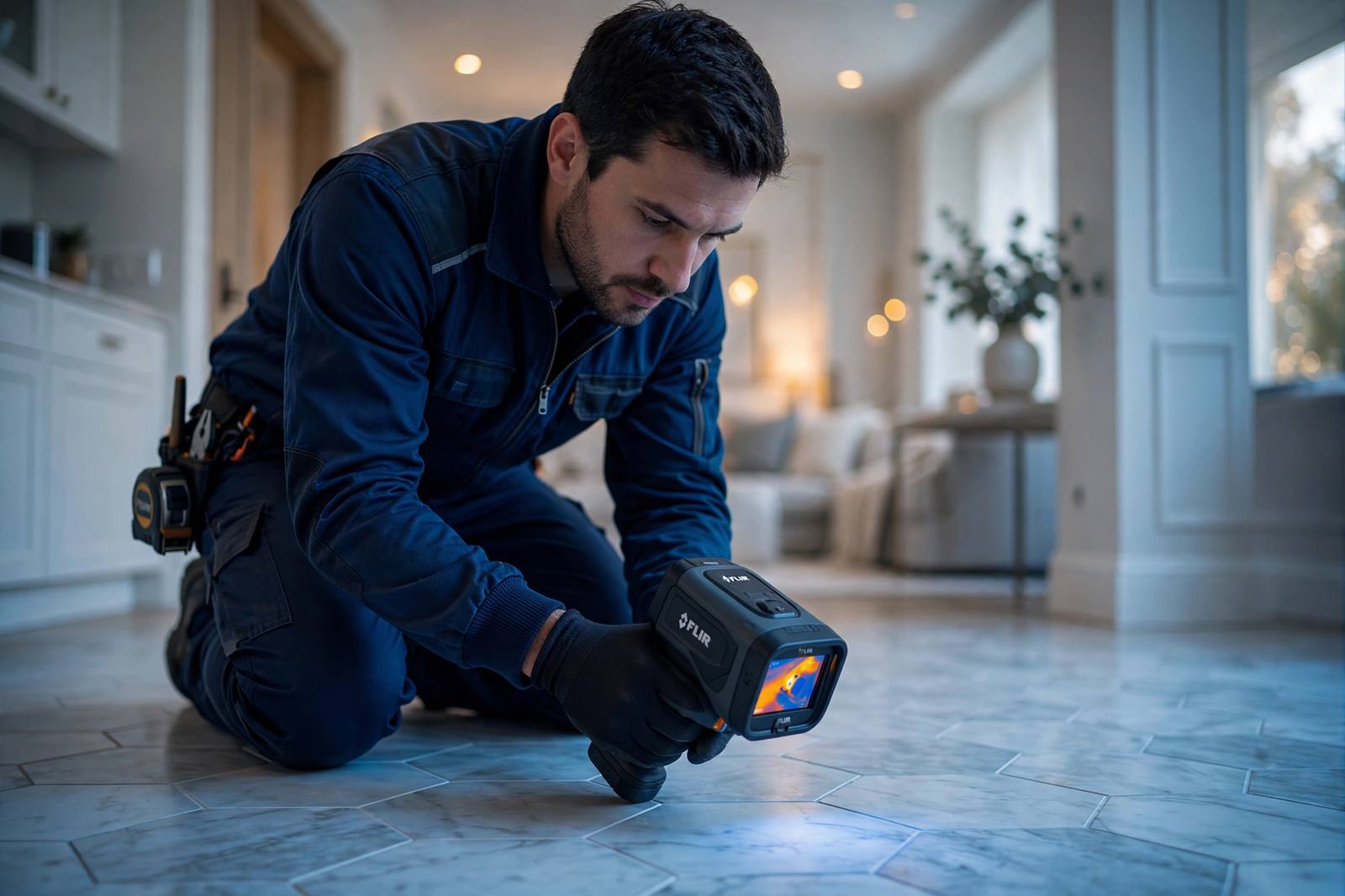
Breaking concrete to find a leak is a last-century approach. Our Las Vegas detection protocol starts with meter and pressure testing to confirm the leak exists and to isolate which system is failing — domestic hot, domestic cold, or sewer — because the detection strategy differs for each. Then we deploy electronic acoustic equipment: water escaping a pinhole under pressure produces a high-frequency signature, and our sensors trace it through the slab to the loudest point, mapping the line's buried path. Thermal imaging provides the visual cross-check: a hot-water leak warms the concrete above it, and the infrared camera renders that heat plume in real time, often narrowing the search to an area the size of a dinner plate. For cold-water lines that don't show thermally, or for very small leaks, we introduce a safe tracer gas into the isolated line and sweep the slab with a sensitive sniffer — gas molecules escape through the concrete exactly where the pipe is breached. Moisture meters and inspection cameras then confirm how far saturation has spread, which matters for the repair plan and any insurance documentation. Las Vegas's dense caliche transmits sound differently than the sandy soils of other markets, so our technicians calibrate their acoustic equipment for local ground conditions rather than running generic settings. A full detection visit takes 60 to 90 minutes. You get the marked location, photos of thermal and acoustic findings, and a written repair estimate — the precision that turns a potential multi-thousand-dollar demolition into one small, surgical opening.
Slab Leak Repair Options in Las Vegas
With the leak mapped precisely, Las Vegas homeowners typically weigh three repair options. The direct spot repair is the fastest: we open the slab at the marked location, remove the failed section of copper, and splice in new pipe — usually finished in a single day. It's the right call when the rest of your plumbing tests healthy and this looks like an isolated failure. Tunneling is the second route: instead of breaking your finished floor from above, we excavate a small tunnel beneath the slab from outside the foundation and repair the line from below. It costs more in labor but leaves tile, hardwood, and carpet completely intact — in Summerlin and Southern Highlands homes with premium flooring, tunneling often pencils out as the cheaper total project once you factor in floor restoration. The third option is a whole-home reroute, and it's the one we recommend most for 1990s and 2000s tract homes whose copper is aging out as a system. We abandon the under-slab lines permanently and run new PEX overhead through the attic and down interior walls. PEX is immune to the mineral and soil corrosion destroying copper in the valley, it handles thermal expansion without stressing joints, and it means no one ever breaks your concrete again. When one pinhole leak appears in 25-year-old tract copper, more are statistically likely — a reroute converts a recurring emergency into a solved problem. We'll price all three approaches honestly so the decision fits your home's condition and your budget.
What Slab Leak Detection & Repair Costs in Las Vegas
A professional slab leak detection visit in Las Vegas runs $175 to $450 — covering the meter and pressure tests, acoustic location, thermal imaging, marked leak location, and a written repair estimate. That diagnostic precision is the highest-value money in the whole project, because it eliminates exploratory demolition. A direct spot repair at one pinpointed location typically costs $2,200 to $6,500, varying with pipe depth, whether it's a hot or cold line, and the flooring that must be removed and restored. Tunneling under the slab from outside runs higher on labor but can be the economical choice when expensive tile or hardwood would otherwise need replacement. A whole-home reroute — new PEX run overhead to replace failing under-slab copper — generally falls between $4,000 and $10,000+ for a typical single-story Las Vegas home, scaling with square footage and fixture count. The dominant cost driver, though, is time: a leak caught in its first weeks is a plumbing repair; a leak that ran for months becomes a plumbing repair plus flooring replacement, drywall work, and mold remediation, easily doubling or tripling the total. On insurance, most Nevada policies exclude the pipe fix itself as wear and tear but cover resulting damage — the slab access, the ruined flooring, the water damage. Document your water bills and keep our detection report; both are exactly what adjusters ask for.
What to Do When You Suspect a Slab Leak
Start with the meter test: shut off every faucet, toilet, appliance, and irrigation zone, then watch your water meter for 15 minutes. Movement with everything off confirms water is escaping — and under the slab is the leading suspect in a Las Vegas home. If you hear an active rush of water or see flooding, shut off the main valve immediately; every hour of flow erodes the compacted soil supporting your slab, and foundation settlement is the expense that dwarfs the pipe repair. Next, document: photograph any damp flooring, note warm spots by room, and gather the last few water bills showing the spike — this file becomes the backbone of any insurance claim. Run a dehumidifier near damp areas if you detect mustiness; the EPA's 24-to-48-hour mold window applies even in the desert, because the sealed cavity under a slab stays wet long after the surface dries. Resist the urge to hire whoever can jackhammer fastest — without electronic detection first, you're paying for holes in your foundation on a guess. A specialist with acoustic and thermal gear finds the leak before touching concrete, which is the entire difference between a surgical repair and a demolition project. Finally, schedule same-day detection. Our Las Vegas technicians confirm the diagnosis, mark the exact location, and deliver a written estimate in one visit — so instead of an escalating emergency, you get a clear plan and a fixed price.
Get a Pinpoint Diagnosis in Las Vegas
No jackhammer guesswork. Thermal imaging + acoustic equipment finds your leak within inches.
☎ Call (877) 762-1902Las Vegas Slab Leak FAQs
How much does slab leak detection cost in Las Vegas?
A professional detection visit in Las Vegas costs $175–$450 and includes pressure testing, acoustic electronic listening, thermal imaging, and a written repair estimate with the leak location marked. It takes about an hour, and the precision is what keeps your repair bill low — there's no exploratory demolition when the leak is mapped to within inches.
Are slab leaks common in newer Las Vegas homes?
Yes — in a sense. Leaks in Vegas slabs most often hit copper lines installed during the 1990s and 2000s building boom, which are now hitting their failure age right on schedule. Colorado River water is extremely hard and mineral-heavy, which attacks the inside of the pipe while alkaline desert soil corrodes it from the outside. Homes built in the last 15 years with PEX are far less vulnerable.
Does homeowners insurance cover slab leaks in Nevada?
Partially, in many cases. Nevada policies typically exclude the failed pipe itself as wear and tear, but cover the resulting damage — breaking through the slab, replacing flooring, repairing water damage. Sudden bursts are covered more readily than slow pinhole leaks. Keep your water bills and our detection report; both strengthen a claim.
How long does slab leak repair take in Las Vegas?
A spot repair is usually done in one day. Tunneling takes one to two days. A whole-home reroute for aging copper takes two to four days depending on the size of the house. Detection itself is a same-day, 60–90 minute appointment, so you can go from suspicion to a confirmed diagnosis and written estimate within 24 hours.
Can someone really find a leak under concrete without breaking it?
Absolutely — but call a slab leak specialist, not a general plumber with a jackhammer. Electronic detection (acoustic listening, thermal imaging, tracer gas) finds the leak before any concrete is touched. A reputable Las Vegas company will show you the thermal image or acoustic reading, mark the spot, and give you a written estimate — that transparency is how you avoid unnecessary demolition.
Should I repair the leak or reroute the plumbing?
For a Vegas tract home with 1990s–2000s copper and one isolated leak, a spot repair or tunneling fix is usually the economical choice. But if you've had two leaks, or the whole neighborhood's copper is failing on the same timeline, a whole-home reroute to PEX ends the cycle — no more breaking concrete, and PEX is immune to the corrosion that kills copper here.
Nearby Cities
Keep Learning
Slab Leak Repair Options: 4 Methods Compared
Slab leak repair options compared: spot repair, tunneling, reroute and repipe. Real costs ($500-$15,000), pros, cons, and how to c…
Do Slab Leak Repairs Come With a Warranty? What to Ask
Do slab leak repairs come with a warranty? Compare coverage by repair type, learn the 7 questions to ask before signing, and what …
Slab Leak: Tunneling vs Rerouting — Which Is Better?
Tunneling vs rerouting for slab leaks: real costs ($4k-$8k vs $2.5k-$6k), timelines, disruption, and when each method wins. Honest…