Slab Leak Detection & Repair in Henderson, NV
Henderson's master-planned communities were built for the long haul — but the copper water lines buried under their slabs weren't. From 1980s Green Valley to 2000s Anthem and Seven Hills, thousands of Henderson homes are hitting the age where hard water inside the pipe and corrosive desert soil outside it finally win. Our same-day pros deliver slab leak detection and repair across Henderson, Nevada, pinpointing hidden leaks with acoustic listening, thermal imaging, and tracer-gas testing — no guesswork, no exploratory jackhammering. Many Henderson homes have long copper trunk runs beneath large slabs, which means a single leak can saturate a wide area before you notice; a warm patch of tile, a climbing water bill, or the sound of running water under a quiet house all deserve immediate attention. We confirm the diagnosis in one visit, mark the exact location, and give you a written repair estimate with every option priced honestly. Call today for same-day slab leak detection in Henderson, before a pinhole leak turns into flooring, drywall, and foundation damage.
Neighborhoods We Serve in Henderson
Green Valley, Anthem, Seven Hills, Inspirada, Cadence, Lake Las Vegas, Whitney Ranch, Mission Hills, Black Mountain — and every ZIP code in between.
Why Henderson Homes Get Slab Leaks
Henderson sits on the same caliche-capped, alkaline desert soil as the rest of the valley — corrosive to copper from the outside while very hard municipal water attacks it from within. Slab-on-grade construction is standard across every master-planned community, and the large single-story floor plans popular here mean longer buried trunk runs with more joints per home. Summer soil-temperature swings add decades of thermal expansion stress to every one of those joints.
Signs of a Slab Leak in Henderson Homes
Henderson slab leaks tend to surface the same way across the city's planned communities, and the earlier you recognize the pattern the cheaper the fix. The most reported sign is a warm or hot spot on tile or laminate flooring — a hot-water line leaking underneath, warming the concrete above it. Because many Henderson homes are large single-stories with long plumbing runs, that warm patch can appear far from any visible plumbing, which confuses homeowners into blaming the water heater instead. Your water bill is the most objective early warning: a sharp, unexplained increase with no change in usage means water is escaping somewhere, and under the slab is the usual answer in this market. Listen in a quiet house with everything off — a hiss or faint running-water sound through the floor means a pressurized line is breached below. Other signals stack up: water pressure dropping at fixtures, carpet edges that feel damp or smell musty, grout lines discoloring, tile that rings hollow when tapped, and baseboards pulling away from walls as moisture wicks upward. Outside, watch for landscaping that stays suspiciously lush right against the foundation, or soil that never quite dries. In Lake Las Vegas and MacDonald Highlands luxury homes with extensive stone and tile, even a small leak can threaten very expensive finishes — the detection call is cheap insurance. If you're checking two or more of these boxes, schedule a professional detection visit now; the leak is not going to seal itself, and every week adds to the restoration scope.
How We Detect Slab Leaks in Henderson
You don't find a slab leak by breaking concrete — you find it with instruments, then break concrete exactly once, in exactly the right place. Every Henderson detection visit we run starts with meter and pressure testing to verify a leak exists and to determine whether it's on the hot-water side, the cold-water side, or the drain system, since each demands a different approach. Next comes electronic acoustic listening: a pressurized leak emits a distinct high-frequency sound, and our sensors trace it through the slab to pinpoint the loudest point along the buried line's path. Thermal imaging provides the visual confirmation — infrared cameras render the heat plume from a hot-water leak in real time, routinely narrowing the location to a patch the size of a dinner plate. For cold-water lines that don't show up thermally, or for extremely small pinholes, we isolate the suspect line and introduce a safe tracer gas, then sweep the slab with a sniffer that detects gas molecules escaping through the concrete at the breach. Moisture meters and compact inspection cameras then map how far saturation has spread, which shapes both the repair plan and your insurance documentation. Henderson's dense caliche transmits sound differently than softer soils, so our technicians calibrate acoustic equipment for local ground conditions instead of running factory defaults. The whole visit takes 60 to 90 minutes. You receive the marked leak location, photos of the thermal and acoustic findings, and a written estimate covering every repair option — the precision that keeps a repair surgical instead of destructive.
Why Henderson Homes Get Slab Leaks
Henderson's slab-leak story is written into its master-plan history. Green Valley, the city's first great planned community, rose through the 1980s and 90s — and its copper water lines are now 30 to 40 years old, squarely inside the failure window for copper under stress. Anthem, Seven Hills, and the communities climbing toward Black Mountain followed in the late 1990s and 2000s; their copper is younger but was installed during the fastest building boom in Nevada history, when speed sometimes outpaced craftsmanship. The chemistry working against all of it is relentless: Henderson's municipal water is very hard, pitting and thinning copper from the inside, while the valley's alkaline caliche soil corrodes it from the outside — a two-front attack that ends in pinhole leaks. Then there's the architecture. Henderson's popular large single-story floor plans mean long copper trunk runs beneath big slabs, with more buried joints per home than a compact two-story — every joint a potential failure point, and every leak able to saturate a wider area before symptoms surface. Summer heat adds the mechanical stress: soil temperatures under sun-baked slabs swing hard between day and night, and decades of thermal expansion and contraction fatigue the metal. Newer communities like Inspirada and Cadence largely used PEX, which resists this corrosion — but the hundreds of thousands of copper-plumbed homes in Green Valley, Whitney Ranch, Mission Hills, and the Anthem villages are aging into their leak years right now, often in neighborhood-wide waves.
Slab Leak Repair Options in Henderson
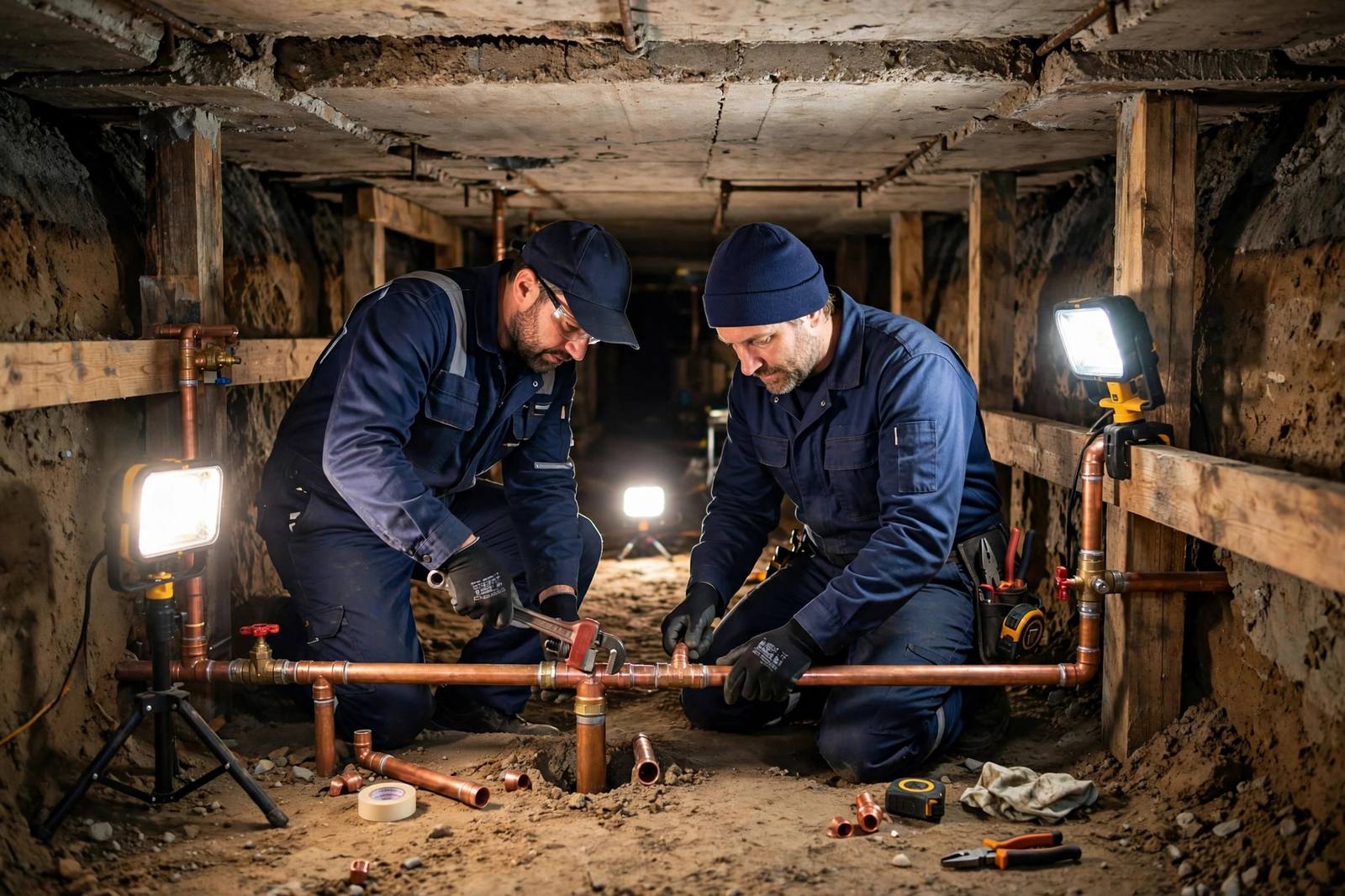
Once we've mapped your leak to within inches, Henderson homeowners generally choose among three repair paths. The direct spot repair is the quickest: we open the slab at the marked location, cut out the failed copper section, and splice in new pipe — typically done in a single day. It makes sense when your plumbing is otherwise sound and this reads as an isolated failure. Tunneling is the second option and a popular one in Henderson: rather than breaking your finished floor from above, we dig a narrow tunnel beneath the slab from outside the foundation and repair the line from below. The labor costs more, but your flooring survives untouched — in homes with tile, hardwood, or high-end stone, tunneling frequently produces the lowest total project cost once you account for floor restoration. The third path is a whole-home reroute, and for 1980s–90s Green Valley copper or 2000s-era tract copper showing its age, it's often the wisest long-term investment. We abandon the failing under-slab lines permanently and run new PEX overhead through the attic and down interior walls. PEX shrugs off the hard-water and soil corrosion that destroys copper here, flexes with thermal expansion instead of fatiguing, and means nobody ever breaks your concrete for plumbing again. When one pinhole appears in 30-year-old copper, the odds of a second within a couple of years are high — a reroute converts that recurring emergency into a finished project. We'll price every option transparently so your decision matches your home's real condition.
What Slab Leak Detection & Repair Costs in Henderson
Professional slab leak detection in Henderson costs $175 to $450 for the complete diagnostic visit — meter and pressure testing, acoustic location, thermal imaging, a marked leak location, and a written repair estimate. That precision is the highest-leverage spending in the entire project, because it rules out exploratory demolition. A direct spot repair at one pinpointed location generally runs $2,200 to $6,500, depending on pipe depth, hot versus cold line, and the flooring that must be lifted and restored. Tunneling under the slab from outside the foundation carries higher labor costs but protects expensive finishes — in Henderson homes with tile or stone floors, it's often the economical choice in total. A whole-home reroute, replacing aging under-slab copper with new overhead PEX, typically falls between $4,000 and $10,000+ for a standard single-story, scaling with square footage and the number of fixtures. The variable that matters most is time: a leak found in its first month is a plumbing repair; the same leak six months later is a plumbing repair plus flooring, baseboards, drywall, and possibly mold remediation — easily doubling the bill. Regarding insurance, most Nevada policies exclude the pipe repair itself as wear and tear but cover the resulting damage: the slab access, destroyed flooring, and water damage to finishes. Keep your water bills showing the spike and our written detection report; adjusters routinely request both, and having them ready speeds your claim.
What to Do When You Suspect a Slab Leak
Begin with the meter test — it's free and definitive. Shut off every faucet, toilet, appliance, and irrigation zone, then watch your water meter for 15 minutes. If it moves with everything off, water is escaping, and in a Henderson home the slab is suspect number one. If you hear an active rush or see water where it shouldn't be, close the main shutoff valve right away; every hour of pressurized flow erodes the compacted soil under your slab, and foundation settlement costs far more than any pipe repair. Next, build your documentation file: photograph damp flooring, note which rooms have warm spots, and pull the last several water bills showing the increase — this becomes the backbone of an insurance claim. If you detect a musty odor, run a dehumidifier near the affected area; the EPA's 24-to-48-hour mold window applies even in our desert climate because the sealed cavity beneath a slab stays wet long after surfaces dry. Don't hire based on who can start jackhammering soonest — without electronic detection first, you're paying for holes in your foundation based on a guess. A qualified specialist locates the leak with acoustic and thermal instruments before touching concrete, which is the entire difference between a surgical fix and a demolition project. Finally, book same-day professional detection. Our Henderson technicians confirm the diagnosis, mark the exact spot, and hand you a written estimate in a single visit — turning an escalating emergency into a clear plan with a fixed price.
Get a Pinpoint Diagnosis in Henderson
No jackhammer guesswork. Thermal imaging + acoustic equipment finds your leak within inches.
☎ Call (877) 762-1902Henderson Slab Leak FAQs
How much does slab leak detection cost in Henderson, NV?
A full professional detection visit in Henderson runs $175–$450. That includes pressure and meter testing, acoustic electronic listening, thermal imaging, a marked leak location, and a written repair estimate — typically completed in 60 to 90 minutes. It's the best money in the project: pinpoint accuracy means the repair needs one small opening instead of exploratory demolition.
My home has original copper — is one leak the end of it?
Sometimes one — but it's the exception. Henderson's master-planned communities were built in waves, and Green Valley homes from the 1980s and 90s are now 30–40 years old, right in copper's failure window. If one pinhole has appeared, the same water chemistry and soil conditions are working on every other buried joint. Get the full system evaluated during detection so you're deciding with complete information.
Will insurance cover a slab leak in Henderson?
Often partially. Most Nevada homeowners policies exclude the failed pipe as wear and tear but cover resulting damage: breaking through the slab, replacing ruined flooring, and repairing water damage. Sudden pipe bursts are covered more readily than slow pinhole leaks. Keep your water bills and our written detection report — adjusters ask for both.
Can a slab leak cause foundation problems?
Yes. Water escaping under pressure washes out the compacted soil and caliche beneath your slab, creating voids. Over months, unsupported sections of slab can settle and crack, doors and windows start sticking, and flooring buckles. In Henderson's larger master-planned homes, the long trunk runs under big slabs mean a leak can undermine a wide area before it's noticed. Early detection prevents foundation-scale damage.
How long does slab leak repair take in Henderson?
A direct spot repair is usually finished in one day. Tunneling takes one to two days. A whole-home reroute — often the smart play for 1980s–90s copper in Green Valley or 2000s-era Anthem and Seven Hills homes — takes two to four days depending on home size. Detection itself is a same-day, 60–90 minute visit.
Spot repair, tunneling, or full reroute — which should I choose?
For an isolated failure in otherwise healthy plumbing, a spot repair or tunneling fix is the economical choice. But if your Henderson home is on 25-to-35-year-old tract copper and you've had one leak, a reroute to PEX usually wins on total cost of ownership — PEX is immune to the hard-water and soil corrosion killing copper here, and you'll never break concrete for a plumbing repair again.
Nearby Cities
Keep Learning
Does Homeowners Insurance Cover Slab Leaks?
Does homeowners insurance cover slab leaks? Usually the water damage, not the pipe itself. What's covered, exclusions, claim tips,…
Epoxy Pipe Lining vs Repiping for Slab Leaks
Epoxy pipe lining vs repiping for slab leaks: real costs ($80-$250/ft vs $4.5k-$15k), lifespan, pros, cons, and limits. Which whol…
Can a Slab Leak Be Fixed Without Breaking Concrete?
Can a slab leak be fixed without breaking concrete? Yes. Rerouting, epoxy lining, and tunneling explained with real costs, timelin…