Slab Leak Detection & Repair in Marietta, GA
Marietta is slab-ranch country, and that makes slab leaks a question of when, not if, for a lot of local homeowners. The sprawling 1970s–1990s build-out across East Cobb, West Cobb, and Whitlock put copper supply lines through concrete slabs in thousands of homes — and those pipes are now old enough to fail. Add Georgia's shifting red clay soil and acidic clay chemistry corroding copper from the outside, and you have one of metro Atlanta's highest concentrations of slab leaks. Whether your home is a brick ranch off Whitlock, a two-story in East Cobb, or an older place near Historic Marietta Square with galvanized-to-copper transitions, the warning signs are the same: unexplained spikes in your water bill, a warm patch on the floor, or the sound of running water when everything is off. Our Marietta technicians locate leaks precisely with acoustic listening equipment and thermal imaging — no exploratory demolition, no guesswork. Call the same day you spot a symptom and we'll confirm the problem and lay out your repair options in one visit.
Neighborhoods We Serve in Marietta
Historic Marietta Square, East Cobb, West Cobb, Whitlock Heights, Delk Road area, Whitlock, Indian Hills, Legacy Park, Wyndham Plantation, Heritage at Vinings — and every ZIP code in between.
Why Marietta Homes Get Slab Leaks
Cobb County's heavy Georgia red clay is one of the most moisture-sensitive soils in the Southeast — it swells dramatically after spring rains and shrinks hard in the dry weeks of late summer. That annual movement heaves concrete slabs and stresses the copper water lines inside them. The clay's slightly acidic chemistry adds a second attack, corroding copper pipes from the outside in. Across Marietta's 1970s–1990s slab subdivisions, that combination is exactly why slab leaks are so common.
Signs of a Slab Leak in Marietta Homes
The symptoms of a slab leak creep up quietly, and Marietta homeowners often blame the wrong culprit first. A water bill that suddenly jumps 30 to 50 percent with no change in household habits is the single most common early warning — plenty of Cobb County customers told us they assumed the water company had raised rates. Next, do the barefoot test: walk across your tile or hardwood first thing in the morning, and a single warm patch underfoot is a strong signal of a hot-water line leak beneath the slab. At night, when the house goes quiet, stand in the kitchen or bath and listen — a faint hissing or the sound of water moving when every tap is off is a red flag. Doors that start rubbing and floors that develop hairline cracks or lifted edges can mean the soil under your slab is washing away, destabilizing the foundation itself. Keep an eye on the ground outside, too: a perpetually damp patch of lawn or soggy mulch bed along the slab edge, especially near Whitlock-area homes where clay soil already holds water, may be leak water finding daylight. Musty or mildewy smells in a room with no history of moisture problems deserve attention — in our humid Georgia climate, a slow leak under the slab can grow mold inside walls long before anything looks wet. And if your water heater seems to run far more often than it used to, a hot-side slab leak may be bleeding heated water continuously.
Why Marietta Homes Get Slab Leaks
Ask anyone in East Cobb when their subdivision went up and you'll hear the 1970s, 80s, or 90s — and that matters, because those decades filled Marietta and its surroundings with slab-on-grade ranch homes whose copper water lines are now hitting failure age. Production builders of that era ran copper supply lines directly through concrete slabs across thousands of lots in East Cobb, West Cobb, and the Whitlock corridor, and after 30 to 50 years, pinhole leaks have become almost routine. The other local wrinkle is Historic Marietta Square and its surrounding older streets, where homes built in the 1920s through 1960s have been replumbed over the decades — often joining old galvanized pipe to newer copper. Those galvanized-to-copper transition joints are classic failure points, weakened by galvanic corrosion where the two metals meet. Underneath everything is Cobb County's dense Georgia red clay, which swells after our wet spring rains and shrinks during the dry heat of late summer. Every cycle flexes the slab a little more, and copper lines embedded in the concrete fatigue and crack. The clay's slightly acidic chemistry compounds the problem by corroding copper from the outside in — a pipe can look fine from the surface and be paper-thin below. Newer subdivisions on the fringes, like parts of Powder Springs and Kennesaw, aren't exempt either: their slab-on-grade construction with thinner-gauge copper means leaks can appear at just 20 to 25 years. When the soil, the pipe era, and the housing stock all point the same way, slab leaks stop being a surprise.
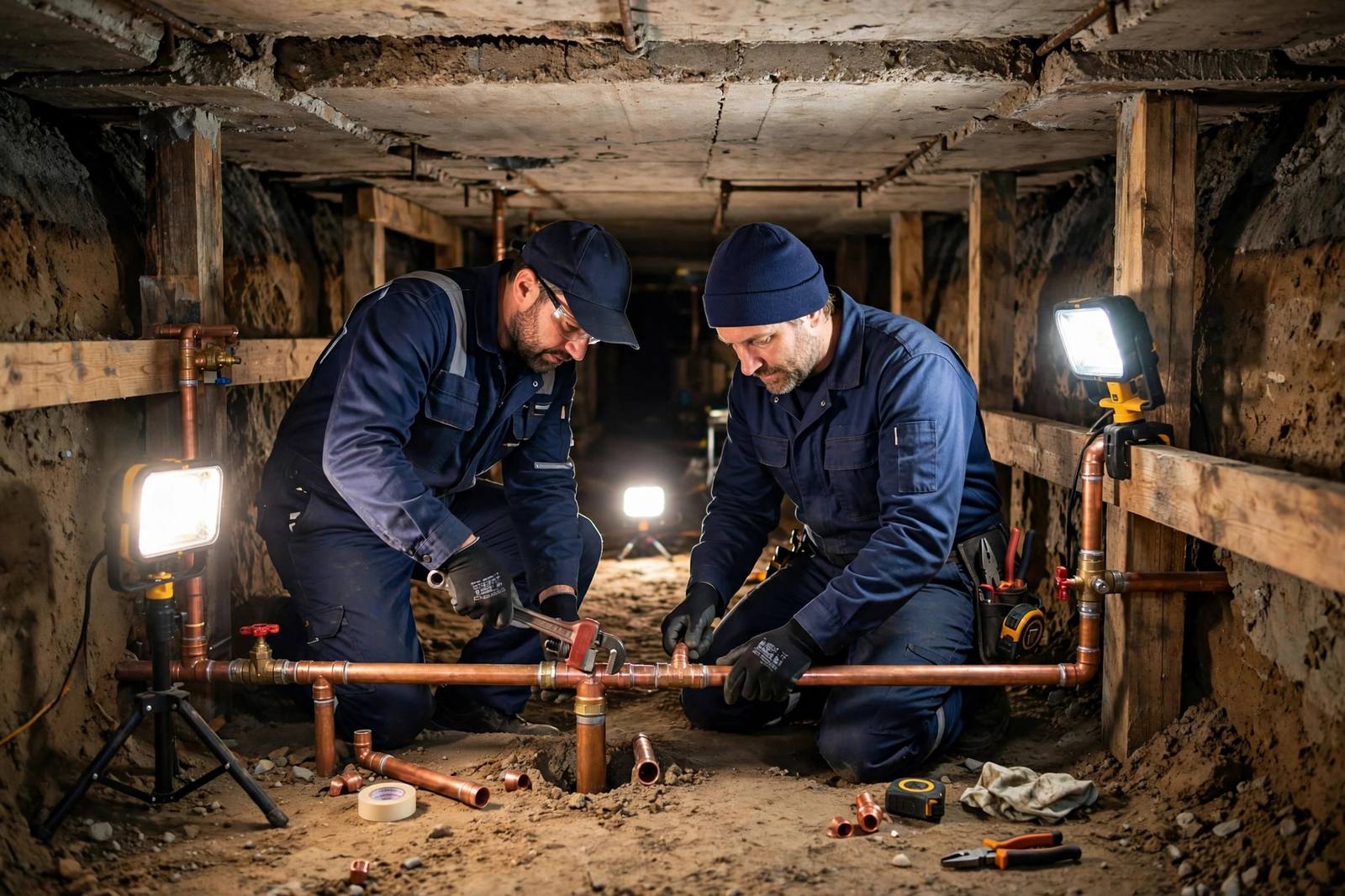
What Slab Leak Detection & Repair Costs in Marietta
Homeowners understandably want the price up front, so here are honest Marietta-area numbers. Professional slab leak detection — a full visit with acoustic listening equipment and thermal imaging — typically costs $175 to $450. The range depends mostly on home size and line layout: a sprawling two-story in East Cobb takes longer to survey than a compact ranch off Delk Road. Think of detection as the cheapest money you'll spend, because pinpointing the leak to within inches is what prevents a contractor from cutting three or four exploratory holes in your slab. For repairs, a spot fix — opening the slab at the exact leak point, replacing the failed copper section, and patching the concrete — usually falls between $2,300 and $4,000. It's a solid choice for a single first-time leak in an otherwise healthy system. A reroute, where we abandon the bad under-slab line and run a new line overhead through walls or the attic, typically runs $2,800 to $5,500 in the Marietta market. Given the age of so much Cobb County copper, rerouting is the repair we recommend most: no slab demolition, no ruined flooring, and a brand-new line that resets the clock. Tunneling — digging under the slab from outside the foundation to reach the leak — costs $4,500 to $6,800 or more. It's the premium option, and it earns it when the leak sits under an expensive hardwood floor or a finished bathroom you'd rather not destroy. Costs climb when leaks sit under kitchens or baths, when multiple leaks show up at once, or when we're dealing with the oldest pre-1960s plumbing near Marietta Square. On insurance: many Georgia policies cover the water damage and even detection, but exclude the pipe repair itself — get the detection report first, because documented proof of the leak's location is the backbone of any claim.
How We Detect Slab Leaks in Marietta
Finding a leak you can't see takes instruments, not guesses, and the process is the same on every Marietta call. First we verify there's an actual leak: a static pressure test on your supply lines shows whether the system is losing water, which rules out false alarms like a faulty meter or an irrigation line bleeding — and with the older sprinkler systems still running in many East Cobb yards, false alarms are surprisingly common. If pressure drops, we move to electronic acoustic listening: a sensitive ground microphone hears the pressurized hiss of water escaping through the concrete, and by comparing readings across the slab we triangulate the leak's position. For hot-water leaks, we scan with a thermal imaging camera — the pooling hot water creates a clear heat signature, especially readable on tile and vinyl floors common in Cobb County ranch homes. When the layout is complicated or we suspect more than one leak, we can charge the line with a harmless tracer gas and sweep the surface with a sniffer to find exactly where it emerges. We also confirm by isolating fixtures and rechecking the meter, so you know the problem is the slab line and not a running toilet or a line to the exterior. The entire visit takes about one to two hours, and what you walk away with is a marked location on your slab — not a vague region, not a guess. That precision is the difference between a surgical repair and a contractor cutting holes across your living room, and it's why professional detection pays for itself even before repair work starts.
Slab Leak Repair Options in Marietta
With the leak located, Marietta homeowners face three realistic repair paths, and the best one depends on your pipe's age, the leak's position, and how much disruption you'll tolerate. The spot repair is the most direct: we cut the slab at the marked location, remove the failed section of copper, install a new piece, and patch the concrete. For a single first-time leak in a younger system — say, a 2000s-built home off Whitlock — spot repair is economical and perfectly appropriate. The catch is that old copper rarely fails just once; if your East Cobb ranch already had a leak repaired three years ago, fixing one pinhole while the rest of the system ages is buying time, not solving the problem. That's where the reroute comes in: we leave the dying under-slab line where it is and run a brand-new line overhead, through walls or the attic, to the affected fixtures. Reroutes are our most common recommendation for Cobb County's 1970s–1990s copper because they dodge slab demolition entirely, leave your flooring untouched, and give you decades of new pipe life. Tunneling is the third option — hand-digging from outside the foundation, under the slab, to repair the pipe from below. It costs the most in labor, but it preserves finished floors and makes sense when the leak hides under a bathroom or a high-end kitchen. Whatever route you lean toward, insist on a firm quote tied to the detected location before work starts, and get every option priced — a reputable company should be able to explain why they'd pick one method over the others for your specific house.
What to Do When You Suspect a Slab Leak
When the signs add up, speed matters more than anything else. Do the meter test immediately: turn off every water source — faucets, ice maker, washing machine — record the meter reading, wait ten minutes, and check again. Any movement means water is escaping somewhere in your system. If the leak is severe, with visibly spreading dampness or pooling, shut off your main water valve right away; in most Marietta homes it's at the meter box near the street or where the line enters the house. Don't wait a weekend to see if things improve — Cobb County's clay soil traps water against the slab, so erosion and mold accelerate fast in our humidity. While waiting for your appointment, photograph any stains, cracked tile, or buckled flooring, and jot down when you first noticed each symptom — that timeline helps with both the repair plan and any insurance claim. Call for professional detection the same day, not a general plumber with a jackhammer: an acoustic survey costs a fraction of one exploratory hole and keeps the repair surgical. And a word of caution — don't let anyone start breaking concrete until the leak is pinpointed. We've seen too many Marietta jobs where guessing turned a $3,000 repair into a $6,000 one, because someone opened the slab in three wrong places first. The correct order never changes: confirm with the meter test, shut off water if the situation is urgent, get the leak located precisely, then choose the repair method with full information.
Get a Pinpoint Diagnosis in Marietta
No jackhammer guesswork. Thermal imaging + acoustic equipment finds your leak within inches.
☎ Call (877) 762-1902Marietta Slab Leak FAQs
How much does slab leak detection cost in Marietta?
Detection usually costs $175 to $450 in the Marietta area. The visit takes one to two hours and uses acoustic listening plus thermal imaging to locate the leak precisely, so you can get accurate, comparable repair quotes instead of paying for exploratory holes in your slab.
Are slab leaks common in Marietta homes?
Yes — many neighborhoods in Marietta and East Cobb are slab ranch country built in the 1970s–1990s with copper supply lines, and those systems are now at the age when pinhole leaks are common. Older homes near Marietta Square add galvanized-to-copper transitions, another failure point. Call for detection as soon as you notice a symptom.
Can I get a slab leak if my Marietta home is on a crawlspace?
Yes. Even if your home is pier-and-beam or has a crawlspace, any slab addition, enclosed patio, garage conversion, or slab-on-grade portion can carry water lines through concrete — and that's all a slab leak needs. Older Marietta homes with slab additions are a frequent call for us.
Will homeowners insurance cover a slab leak in Georgia?
Most standard Georgia policies cover the water damage a slab leak causes — stained floors, mold remediation, drywall — but the pipe repair itself is often excluded as wear and tear. Get professional detection and documentation first, then file promptly with dates and photos; the paperwork makes a real difference.
How long does slab leak repair take in Marietta?
A detection visit takes one to two hours. Spot repairs are usually finished in a day. Reroutes take one to two days depending on line routing, and tunneling runs two to three days. You'll get an exact schedule once the leak is located — no open-ended timelines.
Should I repair the leak or reroute the whole line?
If your home near Marietta Square is 50+ years old with original plumbing, or your East Cobb ranch has already had a leak repaired, a full reroute is usually the better investment. A single first-time leak in a younger system is typically fine as a spot repair. We give you honest guidance based on your pipe's age and condition.
Nearby Cities
Keep Learning
Can a Slab Leak Cause Mold? Health Risks Explained
Can a slab leak cause mold? Yes — often hidden. Learn the EPA 24-48 hour growth window, health risks, warning signs, and the right…
Copper Pinhole Leaks Under Slabs: Repair or Repipe?
Copper pinhole leaks under your slab: what causes pitting corrosion, repair vs repipe costs, and how to decide. Real numbers for f…
Does Homeowners Insurance Cover Slab Leaks?
Does homeowners insurance cover slab leaks? Usually the water damage, not the pipe itself. What's covered, exclusions, claim tips,…