Slab Leak Detection & Repair in Denver, CO
Denver homeowners hear 'slab leak' and think it can't happen to them — after all, most Mile High homes have basements. But a slab leak is any leak in a pressurized water line beneath concrete, and that includes the concrete floor of your basement, the slab under a 1960s ranch in Harvey Park, a garage floor in Lakewood, or the addition built over what used to be a patio. Denver adds a second problem on top: the Front Range's notorious bentonite clay, one of the most expansive soils in America, heaving and shrinking with every snowmelt, summer dry spell, and freeze-thaw cycle. That movement fatigues copper and stresses every joint buried in it. Our Denver slab leak detection team pinpoints under-slab leaks with acoustic listening, thermal imaging, and pressure isolation — usually within inches, usually the same day you call. Basement or not, if your Denver Water bill is climbing for no reason, it's worth finding out why.
Neighborhoods We Serve in Denver
Capitol Hill, LoDo, Cherry Creek, Washington Park, Highlands, Sloan's Lake, Park Hill, Central Park — and every ZIP code in between.
Why Denver Homes Get Slab Leaks
Denver sits on Front Range bentonite clay, among the most expansive soils in the United States — it can swell up to 15 percent by volume when wet and shrink dramatically when dry. Spring snowmelt saturates it, summer bakes it, and winter frost heaves it, subjecting buried pipe to three separate movement cycles a year. That relentless flexing fatigues copper joints and elbows, especially in 1950s–1970s slab-on-grade ranches and in century-old supply lines still buried under basement slabs in Capitol Hill and Washington Park. Bentonite also makes excavation and tunneling slower and more demanding than in sandy soils.
Slab Leaks in Denver: Why Basements Don't Make You Immune
Let's clear up the biggest misconception in Denver plumbing: basements don't make you immune. A slab leak isn't defined by your home having no basement — it's a pressurized supply line leaking beneath a concrete slab, and Denver has concrete slabs everywhere. In Capitol Hill and Washington Park, century-old homes run water lines buried beneath their basement floor slabs, lines laid when Taft was president and now well past their design life. Across Park Hill, Harvey Park, and parts of southeast Denver, 1950s–1970s ranch homes were built slab-on-grade with copper looped right through the concrete — the single highest-risk configuration in the metro. Then there are the hybrids: a 1920s bungalow in Highlands with a 1980s addition poured over a new slab, or a Cherry Creek home where the garage slab hides the line feeding the hose bibbs. Even finished basements get opened for leaks more often than you'd think, because the alternative — ignoring a leak under six inches of concrete — means months of water undermining the very floor you're standing on. The practical takeaway: if you have concrete with pressurized water lines under it, you can have a slab leak. Denver's housing stock, from LoDo lofts to Sloan's Lake ranches, qualifies far more often than owners assume.
Denver's Bentonite Clay: The Swell That Breaks Pipes
The Front Range sits on bentonite clay, and bentonite deserves its fearsome reputation. It's a volcanic clay that can swell up to 15 percent by volume when saturated, generating uplift pressures measured in thousands of pounds per square foot — enough to lift slabs, crack foundations, and, crucially, bend buried pipe. Denver gives it everything it needs to cycle: spring snowmelt and storms saturate the ground, summer heat bakes it dry and shrunken, and winter drives frost deep into the soil, heaving everything upward. Each cycle works buried copper the way repeated bending weakens a wire, concentrating stress at elbows, tees, and solder joints. The 1950s–1970s copper in Denver's slab ranches is now 50 to 70 years old, and in Capitol Hill and older Park Hill blocks you'll still find original early-1900s supply lines under basement slabs that have survived a century of this abuse — until they don't. Bentonite also complicates repairs: it grips excavation walls, swells against shoring, and turns tunneling into slow, careful work. This is genuinely some of the most punishing soil for buried plumbing in the United States, which is why Denver leak detection and repair should come from people who work in it every week, not a generalist guessing at depths and pressures.
Signs of a Slab Leak in Denver Homes
Denver's version of slab-leak symptoms has a winter twist. The headline sign is the same everywhere: a Denver Water bill that climbs sharply with no lifestyle change — check several months, because a slow leak ramps up gradually. Listen for running or hissing water when the house is quiet, especially near basement floors or in slab-on-grade rooms; press your ear to the floor if you have to. Hot-line leaks announce themselves as warm spots on basement or ground-floor flooring, and in winter your water heater may run nearly constantly trying to keep up — don't write that off as 'just cold weather' if your bill is also up. Watch for cracks in basement slabs or foundation walls that keep widening rather than opening and closing seasonally, efflorescence (white mineral crust) appearing on concrete, or damp patches that never quite dry even in Denver's arid air. Musty odors in a finished basement are a red flag in a climate this dry — mold needs sustained moisture, and sustained moisture under a slab means a leak. Low hot-water pressure at fixtures, warm water when you wanted cold, or a recirculation pump that never rests all point the same direction. Any two of these together warrant a professional test, not another month of hoping.
How We Detect Slab Leaks in Denver
Because Denver homes hide pipe under basement slabs, garage floors, and ranch foundations alike, detection here is detective work — and we come equipped for it. Every visit starts with your symptoms and a meter test: if Denver Water's meter shows flow with every fixture off, water is escaping somewhere. We then pressure-isolate the hot and cold systems separately, which tells us which side is leaking and narrows the search dramatically — a hot-side leak, for instance, focuses us on the water-heater loop. Acoustic ground microphones pick up the ultrasonic hiss of water escaping a pinhole through concrete; in a quiet basement this technique is remarkably precise. Thermal imaging earns its keep on hot-line leaks, which paint a clear heat bloom on an otherwise cool basement slab — particularly useful in finished basements where we want to open the smallest possible area. For cold-line leaks or complex layouts, we inject an inert tracer gas that escapes at the breach and is detected at the surface with a sniffer, and we electronically map line routing so the repair plan steers clear of everything else. Most Denver detections wrap up in one to three hours with the leak marked within inches. That precision matters doubly here: in bentonite soil and finished basements, every unnecessary square foot of concrete you open costs real money.
Slab Leak Repair Options in Denver
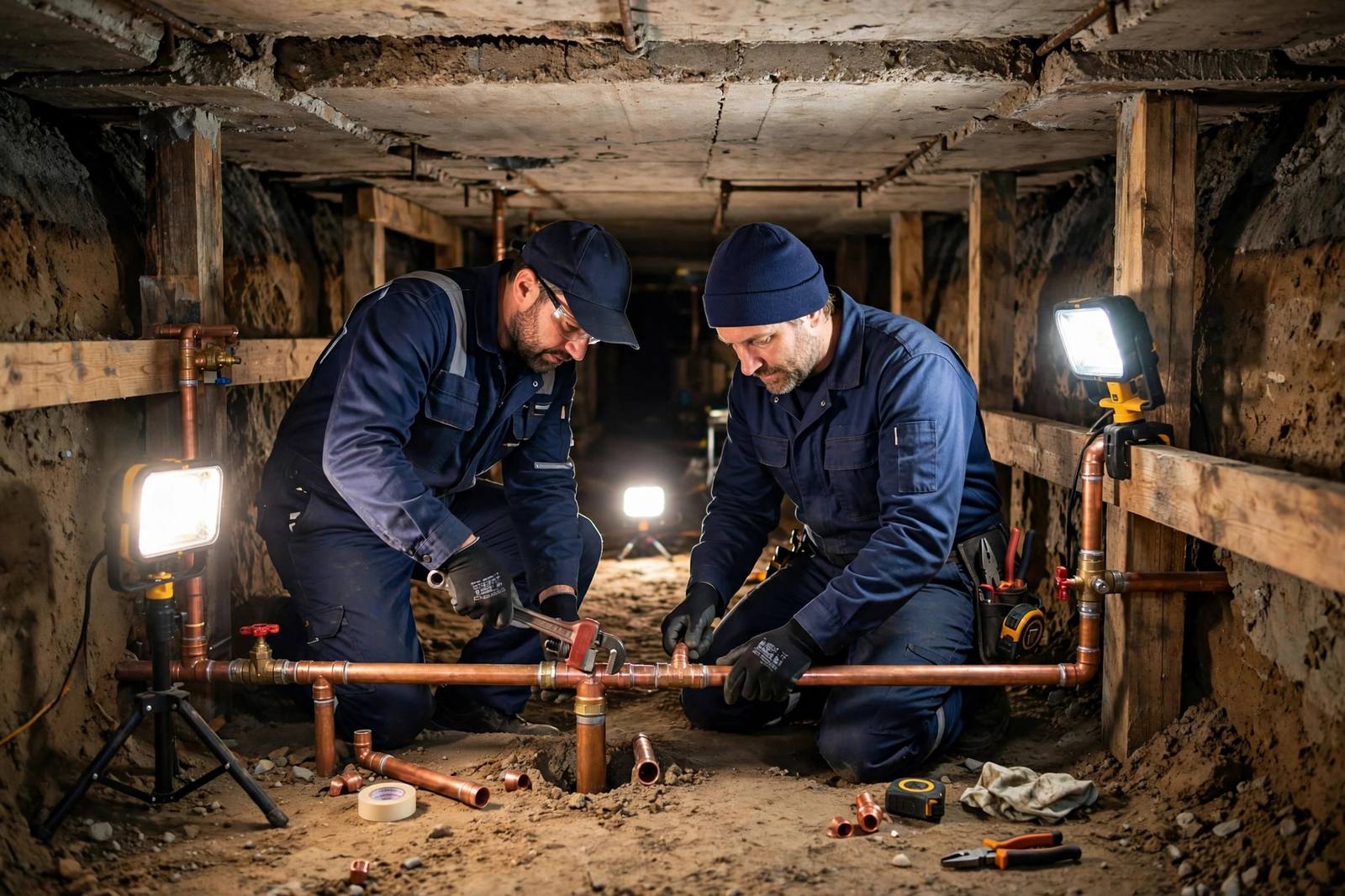
Denver's soil and housing stock shape the repair menu. A <strong>spot repair</strong> — opening the slab at the pinpointed leak and replacing the failed section — works well for a first-time, single leak in an otherwise sound system, and it's the least disruptive option when the leak sits under an unfinished basement floor or garage slab. Where Denver diverges from easier markets is <strong>tunneling</strong>: digging beneath the slab from outside to reach the leak without tearing up interior floors. It's a legitimate option for finished basements you'd rather not demolish, but bentonite makes it slower and pricier here — the clay swells, grips shoring, and demands an experienced crew, so get an honest assessment of whether tunneling's premium is worth it for your situation. Often the smartest Denver fix is a <strong>reroute</strong>: abandon the failed under-slab line and run new PEX through the basement ceiling joists or walls. In homes with open basement ceilings this is fast, clean, and permanently removes the line from the soil that's been attacking it. For Capitol Hill Victorians or Washington Park bungalows with aging copper that's already sprung multiple pinholes, a <strong>repipe</strong> ends the whack-a-mole cycle. We'll walk the property, explain what each option costs in your specific home, and recommend what we'd do if it were our house.
What Slab Leak Detection & Repair Costs in Denver
A full detection visit in Denver runs $175–$475 — meter verification, pressure isolation, acoustic and thermal locating, and a written report with the leak marked and options priced. Repairs generally fall between $2,400 and $7,000, and Denver work trends toward the upper half of that range for honest geological reasons: bentonite excavation is slow, tunneling in swelling clay requires extra shoring and labor, and opening and restoring a finished basement costs more than cutting an unfinished garage floor. A simple spot repair under an accessible slab might land near $2,400–$4,500; a reroute through basement joists often runs $2,800–$6,000 depending on length and fixture count; tunneling and full repipes push higher. Flooring drives the spread too — matching 1920s tile in a Washington Park basement bathroom is a different job than patching concrete in an unfinished utility room. We quote in writing before touching anything, and your detection fee applies toward the repair. On insurance: Colorado policies commonly cover sudden and accidental water damage but exclude the pipe repair itself, wear and tear, and — critically in bentonite country — damage attributed to earth movement or settling. Document meter readings, bills, and damage from the start. Most Denver repairs are completed in one to three days, with the detection fee credited toward your final invoice.
What to Do When You Suspect a Slab Leak
Take these steps in order. First, verify: with every fixture off, check your water meter — Denver Water meters have a leak indicator that moves with even small flows. Note the reading, wait an hour without using water, and check again. Second, if water is actively running or you see spreading dampness, shut the main valve; in Denver it's typically at the meter pit near the curb (you may need a curb key) or where the line enters the basement. Third, document everything — meter photos, bill comparisons, damp spots, warm floor areas. Insurers in Colorado scrutinize slab-leak claims closely, and a paper trail from day one is your best asset. Fourth, protect against freeze compounding the problem: if the leak is on an exterior-wall line and temperatures are dropping, keep the heat on and cabinet doors open — you don't need a burst pipe on top of a slab leak. Fifth, don't start breaking concrete yourself; blind demolition in bentonite soil destroys evidence and multiplies restoration costs. Finally, call for detection before authorizing any repair — anyone quoting a fix without locating the leak is guessing. We run same-day appointments across Denver, Aurora, Lakewood, Littleton, and Arvada, and most visits end with a marked spot and a written plan within a few hours.
Get a Pinpoint Diagnosis in Denver
No jackhammer guesswork. Thermal imaging + acoustic equipment finds your leak within inches.
☎ Call (877) 762-1902Denver Slab Leak FAQs
Can a Denver home with a basement still have a slab leak?
Absolutely. A slab leak is a leak in a pressurized water line beneath concrete — and that includes the concrete floor of a basement. Many Denver homes run water lines under their basement slabs, and 1950s–1970s slab-on-grade ranches, garage slabs, and room additions put even more pipe in the ground. If your water bill spikes or you hear running water under the floor, the basement doesn't rule out a slab leak.
How does bentonite clay cause slab leaks?
Bentonite is among the most expansive clays in the country. It can swell up to 15 percent by volume when wet, exerting thousands of pounds of pressure per square foot, then shrink dramatically as it dries. That cycle heaves and settles the soil under your slab, bending buried pipe and fatiguing joints and solder connections. Denver's spring snowmelt saturates it, summer dries it, and winter freezes it — three separate assaults per year on every buried line.
What does slab leak repair cost in Denver?
Detection visits run $175–$475. Repairs typically fall between $2,400 and $7,000, with Denver jobs trending toward the upper half because bentonite excavation is slow, tunneling needs extra shoring in swelling soil, and finished basements cost more to open and restore. An overhead reroute through an unfinished basement ceiling is often the most economical fix. You get a written quote before any work begins.
Does homeowners insurance cover slab leaks in Colorado?
Often yes for the resulting water damage, with big caveats. Colorado policies commonly cover sudden and accidental discharge — ruined flooring, drywall, mold remediation — but usually exclude the cost of repairing the pipe itself, wear and tear, and anything tied to earth movement or foundation settling, which insurers love to invoke in bentonite country. Document meter readings, bills, and damage from day one and read your exclusions before filing.
Is tunneling safe in Denver's expansive clay soil?
Tunneling is safe in bentonite when it's done right, but it is slower and more expensive here than in sandy soils — the clay swells, grips, and can shift, so proper shoring and an experienced crew are non-negotiable. For many Denver homes the simpler answer is a reroute through the basement ceiling or walls, which avoids excavation entirely. We'll recommend the approach that fits your soil conditions and your home's layout, not the one with the biggest invoice.
How do I tell a slab leak from normal freeze-thaw foundation movement?
Seasonal freeze-thaw cracks open and close with the weather; they're usually thin, and they don't come with water symptoms. A slab leak is persistent: the water bill stays high month after month, the warm spot doesn't go away, the sound of running water continues whether it's January or July. If your 'settling crack' is accompanied by any water symptom — bill spike, dampness, musty odor, low pressure — get it tested rather than assuming it's just the soil moving.
Nearby Cities
Keep Learning
Can a Slab Leak Be Fixed Without Breaking Concrete?
Can a slab leak be fixed without breaking concrete? Yes. Rerouting, epoxy lining, and tunneling explained with real costs, timelin…
Hot Spot on Your Floor? How to Tell If It's a Slab Leak
Warm spot on your tile or floor? Learn how to tell if it's a hot water slab leak — DIY confirmation tests, pro detection, repair o…
How Long Does Slab Leak Repair Take? Realistic Timelines
How long does slab leak repair take? Spot repairs: 1 day. Reroutes: 1-2 days. Tunneling: 2-4 days. Realistic timelines, costs, and…